An RPA implementation is a programme, not a project, and the six phases below are the same whether you are automating one process or a hundred. What separates a programme that scales from one that stalls is rarely the tool. It is whether anyone owns the process afterwards, whether the business case survives contact with year two, and whether governance arrives before the first audit finding rather than after it.
This is the RPA journey from candidate selection to a governed programme — the automation journey that most programmes get wrong at the same three points. Each phase answers one question and produces one artefact, and each has a failure mode that shows up months later if you skip it.
The six phases at a glance #
| Phase | Question it answers | What you produce | How it fails |
|---|---|---|---|
| 1. Identify | What is worth automating? | A ranked pipeline of candidates | Automating what is easy to automate rather than what is worth it |
| 2. Optimise | Is the process worth having at all? | A simplified, documented to-be process | Automating the waste you already had |
| 3. Justify | Why should anyone fund this? | A business case with a measured baseline | A number nobody signed off, which cannot be defended in year two |
| 4. Select | What will we run it on? | A platform and licensing decision | Buying a platform before you know the processes |
| 5. Pilot | Does this work here? | One automation in production, documented | A pilot that proves the tool works rather than the process |
| 6. Scale | Who runs this next year? | A centre of excellence and a governance model | Scaling delivery without scaling control |
Phase 1 — Identify the candidates for automation #
This is the “what” phase. You are looking for processes that are rule-driven, repetitive, high-volume, data-heavy and prone to human error — the same criteria every guide lists, and they are still right.
The change since those lists were written is process mining. Rather than asking people which processes are painful, process mining reads your system logs and reconstructs the real workflow: how long each step takes, where the handoffs pile up, and which variants exist that nobody documented. It is the difference between a workshop and evidence, and it is now table stakes in the enterprise suites and available from the larger vendors.
Whatever method you use, rank RPA candidates rather than listing them. A useful scoring model weighs transaction volume, rule density, number of systems touched, stability of the interface and the cost of a failure. What you want out of this phase is a pipeline in priority order, not a workshop’s worth of ideas.
Phase 2 — Optimise before you automate #
Automating a bad business process gives you a fast bad one, and you now have to maintain it. This is the RPA equivalent of paving a footpath nobody walks. Before anything is built, run the process through the techniques your quality team already knows — Lean, Kaizen, whatever the organisation uses — and remove the steps that exist only because a form is badly designed or a system is slow.
This phase is unpopular because it delays the visible work and produces no demo. It is also where most of the return hides. A process simplified from eleven steps to six is cheaper to automate, cheaper to maintain and less likely to break.
Document the to-be process while you do it. That document becomes the specification, the test script and the operations manual, and it is the single artefact that determines whether anyone can maintain the automation later.
Phase 3 — Build the business case #
The business case is the “why”, and most of them are built on numbers that were never measured. Before and after requires a before.
A defensible case contains five things:
- A measured baseline. How many transactions, how long each takes, how many people, how often it errors. Measured, not estimated.
- ROI and business value over a stated period, including the licence, the build effort and the ongoing maintenance — not just the hours saved.
- The span of control between humans and bots: how many exceptions one person can handle, because that number, not the robot count, sets your operating cost.
- A redeployment plan. Automation rarely removes people; it moves them. Saying so at the start is what stops the programme becoming a headcount fight halfway through.
- A named business owner for the process, plus the stakeholders who will actually have to live with the change, both of whom sign the case and own the result.
That last one is the item most often missing and the one that predicts success best. If no business unit will put its name on the outcome, the automation has no owner when a screen changes.
Phase 4 — Choose the platform and the vendor #
Build or buy is the first RPA decision, and it is usually buy. In-house automation makes sense when the process is genuinely unique, when the estate is already code-first, or when data cannot leave the network — not as a default.
On the buy side, the trap is choosing from a feature table. Choose from your pipeline instead: take the three processes you ranked highest in phase 1, including their messiest step, and make each vendor automate those three with your data. The tool that copes with your worst process is the one to buy. The RPA tools comparison covers the shortlist and what each is genuinely good at.
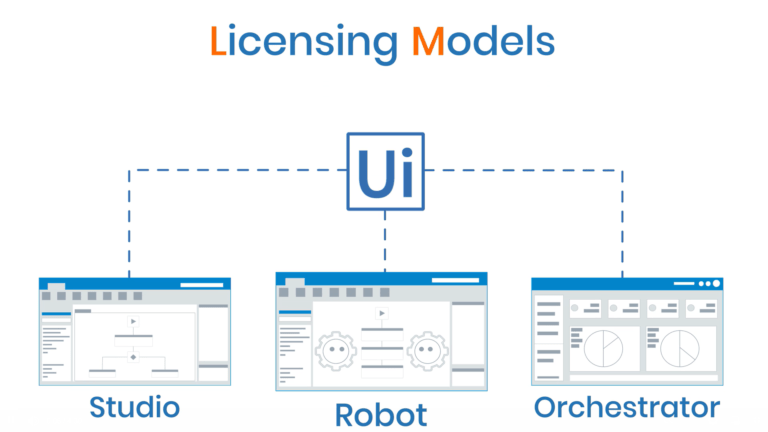
Licensing deserves its own conversation, because it is where budgets go wrong after the decision is made. Whether you pay per user, per robot, per unit of consumption or per plan changes what “cheap” means at your volume — and the answer differs between vendors more than the feature lists do. The UiPath licensing guide works through the largest vendor’s model in detail, and the same questions transfer to the others.
One more input worth having: what comparable organisations actually automate. The named examples are useful less for the logos than for the pattern — the work is invoices, registrations, claims and tickets almost everywhere.
Phase 5 — Run a pilot that proves the right thing #
Most pilots prove that the tool works. That was never in doubt. A pilot should prove that your process, your data and your team can run an automation in production without it becoming someone’s second job.
The delivery question is who builds it. A trained RPA developer is faster with the tool but slower to understand the process; subject matter experts understand the process but are learning the tool. Because the platforms are genuinely low-code, the SME is often the better first choice — provided they are given the time rather than the task being added to their existing workload. The RPA training guide covers what that learning actually involves and what it costs.
Run the pilot in short, agile cycles rather than one long build. Automation work is iterative by nature — you discover half the exceptions by trying to handle them — and a pilot organised as a six-week waterfall will spend five weeks discovering what a fortnight of iteration would have shown.
Before you start, write down what the pilot has to demonstrate: which process, in production, handled by whom, with what error rate, for how long. Then evaluate it honestly against that, including what did not work. The findings from a pilot are worth more than the automation it produced, because they are the only cheap opportunity to learn them.
Phase 6 — Scale, with governance arriving before it is needed #
This is the phase the older guides — including the first version of this page — leave out, and it is where most programmes fail. Going from one automation to twenty is not twenty times the delivery work; it is a different operating model.
Governance. Who approves a new automation? Who can change one in production? Who holds the credentials, and where? Answer these before you have twenty bots, because retrofitting them means an audit finding rather than a design decision.
A centre of excellence. A small central team that owns the best practices, the platform, the pipeline and the re-usable components, while the business units own their own processes. Without a CoE, every team reinvents the same error handler; with a badly run CoE, every team waits six weeks for one.
Maturity. Programmes move through recognisable stages, and knowing which one you are in tells you what to fix next:
| Stage | What it looks like | What to fix next |
|---|---|---|
| 1. Ad hoc | Individual automations built by enthusiasts, no standards | Pick one process and finish it properly |
| 2. Repeatable | A pipeline, a delivery method, a named owner | Standards and a shared component library |
| 3. Managed | Governance, a CoE, monitoring and an operating model | Process selection quality and business ownership |
| 4. Optimising | Automation is part of how the business redesigns work, not a side project | Nothing structural — keep the pipeline honest |
The digital workforce. At scale you are managing a workforce, and it needs the things a workforce needs: onboarding, change control, monitoring, an escalation path and a retirement plan for automations that no longer earn their keep. Organisations that manage bots like servers do better than those that manage them like scripts.
What actually makes these programmes fail #
- Automating a process nobody owns. The most reliable predictor of failure, and the cheapest to fix at the start.
- Choosing a process that is about to change. A system replacement or a reorganisation mid-build guarantees rework.
- Skipping the measurement. No baseline means no defence of the budget in year two.
- Buying the platform first. Programmes that shop for a tool and then hunt for processes stall with a licence they cannot justify.
- Scaling delivery without scaling control. Twenty ungoverned automations is a bigger risk than one badly built one.
- Treating it as an IT project. IT supplies the platform; the business owns the process, and therefore the result.
None of those is about the software. All of them are decisions made in the first three phases — which is why the pitfalls below are worth reading before you start rather than after.
What has changed since this page was first written #
The six phases have not changed. Three things around them have.
Agentic automation sits alongside deterministic bots. UiPath added an Agentic Automation Associate certification in 2026 and the term runs through every major platform’s documentation. The practical effect on implementation is that process selection now has a third option — a bot, an agent with tools, or a person — and choosing between them is a judgement call you make in phase 1 rather than a technical detail. The agentic frameworks guide covers the landscape.
Process mining moved from luxury to default, which changes phase 1 from a workshop into an evidence exercise, and makes the pipeline far easier to defend.
Document work became the main event. Where the original version of this page was about moving data between screens, most of the value now sits in reading documents and handling exceptions — which means the business case, the pilot and the operating model all have to account for a human review queue rather than a clean straight-through run.
Frequently asked #
How long does an RPA implementation take? #
A single automation takes two to six weeks including testing; the second is faster because the standards and logging already exist. Reaching a governed programme with a centre of excellence takes most organisations twelve to eighteen months, and the delivery speed is rarely the constraint — process selection and business ownership are.
Should RPA be treated as a project or a programme? #
A programme. A project has an end date and hands over; a programme keeps a pipeline, a platform and an operating model running. Organisations that treat each automation as a separate project end up with twenty unmaintained bots and no way to explain them.
What is an RPA centre of excellence? #
A small central team that owns the standards, the platform, the pipeline and the reusable components, while business units own their processes. It exists to stop every team solving the same problems differently, and it fails when it becomes a bottleneck rather than an accelerator.
Do I need process mining to start? #
No, but it helps. Early on, workshops and process walkthroughs are enough to find candidates. Process mining earns its place once you have more candidates than capacity, because it tells you which processes are genuinely high-volume and where the variants are, from logs rather than opinions.
What should an RPA pilot prove? #
That one process can run in production with your data, owned by a named business person, at an error rate you can live with. Not that the tool works — that was never in question. Write the success criteria before the build starts, and include what would count as failure.
Who should own an RPA programme? #
The business, through a named owner per process, with a central team supplying the platform and standards. Programmes owned entirely by IT tend to deliver automations nobody asked for; programmes owned entirely by the business tend to build the same thing four times.
Related reading #
- All robotic process automation guides
- Robotic process automation: what it is, where it pays
- Best RPA tools in 2026 and how to choose one
- UiPath license in 2026: plans, user tiers and real costs
- Which companies use RPA, and what they automate
- Robotic process automation training: the free-first guide
- Agentic AI frameworks: how to choose one